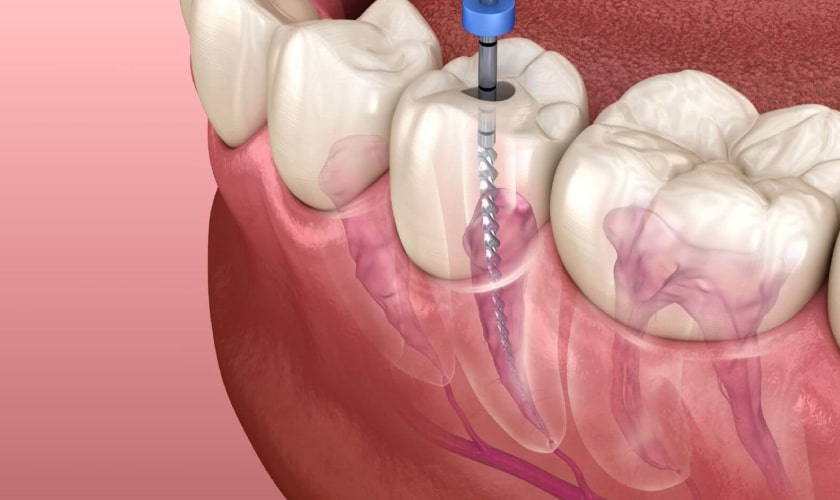
A root canal saves a tooth that would otherwise be lost. When decay or injury reaches the nerve inside a tooth, root canal treatment removes the infection, cleans the canal, and seals it — keeping your own natural tooth in place and taking the pain away.
Why a root canal over losing the tooth
The old reputation of root canals as something to dread belongs to another era of dentistry. With modern techniques and anaesthetic, the procedure feels much like having a filling. And nothing replaces a natural tooth as well as keeping it: pulling the tooth instead means living with a gap or paying more, later, for an implant or bridge — along with the bone loss and shifting teeth that follow an extraction.
- Keeps your own natural tooth and its root
- Relieves the pain of infection at its source
- Usually far more comfortable than its reputation suggests
- Avoids the greater cost and bone loss of extraction
How we make sure it's done right
Success comes down to precision and cleanliness. We diagnose carefully, work under magnification with fine rotary instruments, and follow a strict sterile technique to fully clean and seal every canal. You are kept comfortable and informed at every step — patients regularly tell us they felt almost nothing. We then protect the treated tooth, usually with a crown, so it serves you for years to come.
Common questions about root canal treatment
Is root canal treatment painful?
This is the fear that keeps people away, and it is largely out of date. The procedure is carried out under local anaesthetic, and for most patients it feels much like having a filling. What actually hurts is the infection beforehand — root canal treatment is what removes that pain, not what causes it.
How many visits does a root canal take?
Many teeth can be completed in a single longer appointment. Others — particularly molars with several canals, or teeth with active infection — are better treated across two visits so the canals can be properly disinfected between them. We will tell you which applies after examining and imaging the tooth.
Will I need a crown afterwards?
Usually, yes, especially for back teeth. A tooth that has had root canal treatment is more brittle and prone to fracturing under chewing forces. A crown holds it together and is what turns a successful root canal into a tooth that lasts years rather than months.
Is it better to just extract the tooth?
Extraction looks cheaper and simpler on the day, but it rarely ends there. Losing a tooth starts bone shrinkage and lets neighbouring teeth drift, and replacing it later with an implant or bridge costs considerably more than saving it would have. Where a tooth is restorable, keeping your own is almost always the better decision.
How long does a root canal treated tooth last?
Properly treated and properly restored, it can last for the rest of your life. The failures we see are usually teeth that were never crowned afterwards, or where decay was allowed to get back in around the edges.